Select Language
Tread hardness—commonly measured on the Shore scale (Shore A for softer elastomers, Shore D for harder plastics and resins)—is one of the most influential factors in caster performance. It affects how easily a caster rolls, how much noise it generates, how well it protects the floor, and how much shock it absorbs. Selecting the wrong durometer can lead to premature wheel wear, floor damage, or excessive pushing effort.
At China Zhongshan FFIBU Casters Co., Ltd, the FFIBU brand offers caster wheels across a broad spectrum of tread hardnesses, helping customers match mobility performance to real-world application demands.
Scale | Typical Range | Material Examples | Characteristics |
|---|---|---|---|
Shore A | 60A–95A | Rubber, TPR, Soft Polyurethane | Softer, higher shock absorption, quieter ride |
Shore D | 50D–85D+ | Hard PU, Nylon, Phenolic, Acetal | Harder, lower rolling resistance, higher load capacity |
Note: The higher the number, the harder the material.
Best for: Uneven floors, outdoor use, noise reduction, delicate load protection.
Absorb minor floor irregularities and vibrations
Roll quietly and comfortably
Provide good grip
Trade-off: Higher rolling resistance; may "flat-spot" if left under heavy static load for long periods
Typical FFIBU Applications: Medical carts on older floors, food-service trolleys, light industrial dollies.
Best for: General-purpose indoor use on smooth to slightly imperfect floors.
Balance between shock absorption and easy rolling
Non-marking options available in polyurethane
Suitable for moderate loads and mixed traffic
Typical FFIBU Applications: Warehouse carts, assembly line trolleys, institutional equipment.
Best for: Heavy loads, smooth concrete or epoxy floors, high-load ergonomics.
Lowest rolling resistance → easier to push under heavy weight
Highest load-carrying capacity per wheel size
Resist deformation under static heavy loads
Trade-off: Minimal shock absorption; transmits vibration; less grip; can be noisy
Typical FFIBU Applications: Heavy-duty die carts (phenolic, nylon, forged steel), high-capacity platform trucks on finished floors.
Ask these questions when specifying FFIBU caster tread hardness:
What type of flooring will the caster roll on?
Rough / uneven → softer tread
Smooth / sealed concrete → harder tread acceptable
How heavy is the total load (including dynamic factors)?
Very heavy → harder tread or high-durometer PU
Light to medium → softer elastomer options
Is noise or vibration a concern?
Yes → softer Shore A material
No → harder material OK
Is floor protection a priority?
Yes → non-marking PU (medium hardness)
Less critical → phenolic, nylon, or steel
Will the caster sit under static load for long periods?
Yes → avoid very soft urethane that may flat-spot; choose medium-hard PU or harder
FFIBU Wheel Material | Approx. Hardness | Typical Use |
|---|---|---|
Thermoplastic Rubber (TPR) | Shore A 70–85 | Quiet, floor-safe, light–medium duty |
Polyurethane (PU) Elastomer | Shore A 90–95 / Shore D 55–60 | Versatile, non-marking, medium–heavy duty |
Rubber (Gray/Black) | Shore A 65–80 | Shock absorbing, budget-friendly |
Nylon / Acetal (POM) | Shore D 70–80+ | Hard, low rolling resistance, chemical resistant |
Phenolic Resin | Shore D 80–85+ | Extreme loads, high temp, dry floors |
Forged / Cast Steel | Metal | Maximum load, rough floors |
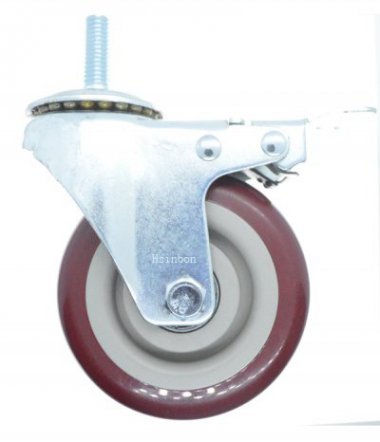
Choosing the correct tread hardness ensures your caster performs as intended—protecting both your equipment and your floors. With the broad material and durometer options available under the FFIBU brand from China Zhongshan FFIBU Casters Co., Ltd, matching the right wheel to your application is straightforward, whether your priority is ergonomics, floor care, load capacity, or noise control.
 中文简体
中文简体  English
  Español
  العربية
  Français
  Русский
  Português
  Deutsch
  日本語
日本語  한국어
한국어  Tiếng Việt
  हिन्दी
  Italiano
  Nederlands
  Türkçe
  Polski
  ไทย
ไทย  Română
  বাংলা
বাংলা  Українська
  עברית
עברית  Lietuvių
  Bahasa Indonesia
  Svenska
  Magyar
  Dansk
Dansk  Suomi
Suomi  Čeština
  Ελληνικά