Select Language
When you look at a caster wheel rolling smoothly under a heavy machine, a hospital bed, or a warehouse cart, it is easy to overlook the engineering inside. A high-quality caster is not a single piece — it is an assembly of several precise components working together. Understanding these parts helps you choose the right caster for your application.
At **China Zhongshan FFIBU Casters Co., Ltd.** , every caster is built with careful attention to each of the following components.
**1. Top Plate or Stem (Mounting Attachment)**
The top plate or stem is the part that connects the caster to the equipment. A top plate is a flat metal piece with holes for bolts, ideal for heavy loads and stable mounting. A stem is a vertical rod that inserts into a socket, commonly used on office chairs or light carts. The choice between plate and stem depends on your equipment design.
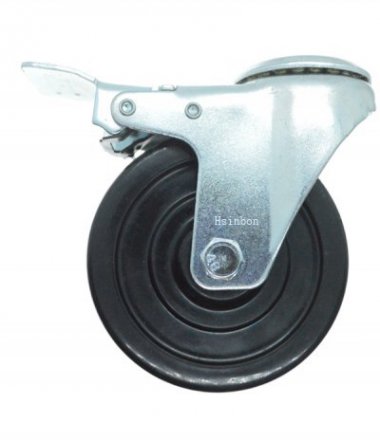
**2. Bracket (Caster Frame)**
The bracket holds the wheel and allows it to swivel or roll. There are two main types:
- **Rigid bracket:** The wheel moves only forward and backward, like a fixed cart wheel.
- **Swivel bracket:** The wheel can rotate 360 degrees, allowing easy turning and maneuverability.
The bracket material is usually steel, and its thickness directly affects load capacity.
**3. Kingpin**
The kingpin is the vertical bolt that connects the swivel bracket to the top plate. It allows the bracket to rotate. In heavy-duty casters, **dual ball bearings** or a **thrust bearing** is placed around the kingpin to reduce friction and ensure smooth swiveling.
**4. Wheel**
The wheel itself is the most visible part. Different applications need different wheel materials:
- **Polyurethane (PU):** Quiet, floor-protective, and wear-resistant.
- **Nylon:** Hard, high load capacity, but noisier.
- **Rubber:** Soft, shock-absorbing, suitable for manual carts.
- **Cast iron / Steel:** Extreme heavy loads, but can damage floors.
Each material has its own thickness, diameter, and tread shape.
**5. Bearing**
Inside the wheel hub, bearings reduce rolling resistance. Common types include:
- **Plain bore (no bearing):** For very light, slow movement.
- **Single ball bearing:** Smoother rolling, suitable for medium loads.
- **Double ball bearing:** Maximum smoothness and durability for frequent use.
- **Roller bearing:** For extremely heavy loads.
**6. Axle**
The axle is a steel pin that passes through the center of the wheel and the fork of the bracket. It holds the wheel in place. It is secured with a nut or a rivet. A thick, hardened axle prevents bending under heavy loads.
**7. Lubrication and Seals**
To keep a caster moving quietly and smoothly over years, proper lubrication is essential. Many casters include grease fittings (zerks) to add lubricant. Seals (washers or rubber rings) keep dirt and dust out of the bearings and kingpin area. This is especially important in factories or outdoor environments.
**8. Brake (Optional)**
Many casters include a brake mechanism. The most common is a **side brake** — a small metal lever attached to the bracket. When pressed down, it locks the wheel or the swiveling action. Total-lock brakes lock both rolling and swiveling, which is critical for medical beds or work platforms.
**Why Component Quality Matters**
A caster is only as strong as its weakest part. A high-quality wheel with a weak bracket will fail. A strong bracket with a soft axle will bend.
That is why **China Zhongshan FFIBU Casters Co., Ltd.** carefully selects and tests each component — from the steel grade of the bracket to the hardness of the wheel tread. The goal is not just to make a caster that rolls, but to make one that rolls reliably for thousands of miles under real working conditions.
**Conclusion**
The next time you see a caster wheel, remember: it is not just a wheel. It is an assembly of a mounting attachment, a bracket, a kingpin, a wheel, bearings, an axle, seals, and often a brake. Each part plays a critical role. When all are designed and manufactured with precision — as at **China Zhongshan FFIBU Casters Co., Ltd.** — you get a caster that performs, lasts, and protects your equipment.
 中文简体
中文简体  English
  Español
  العربية
  Français
  Русский
  Português
  Deutsch
  日本語
日本語  한국어
한국어  Tiếng Việt
  हिन्दी
  Italiano
  Nederlands
  Türkçe
  Polski
  ไทย
ไทย  Română
  বাংলা
বাংলা  Українська
  עברית
עברית  Lietuvių
  Bahasa Indonesia
  Svenska
  Magyar
  Dansk
Dansk  Suomi
Suomi  Čeština
  Ελληνικά