Select Language
Not all carts are created equal, and neither are the casters that support them. One of the most common—and costly—mistakes in equipment specification is mismatching caster duty rating to actual load requirements. Using light duty casters on heavy loads can cause premature failure, while over-specifying heavy duty casters on simple applications adds unnecessary cost. At China Zhongshan FFIBU Casters Co., Ltd, our FFIBU product range covers both ends of the spectrum, engineered for safety, durability, and value in their intended applications.
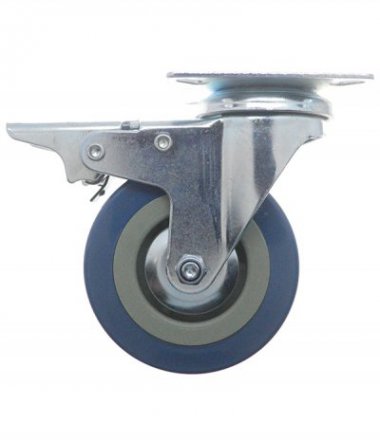
Light duty casters are designed for low-load, frequent-maneuverability applications. Typically rated from 50 kg (110 lbs) to around 150 kg (330 lbs) per caster, they feature smaller wheel diameters (usually 50 mm–100 mm / 2"–4") and lighter-gauge steel or pressed-steel brackets.
Common Uses for FFIBU Light Duty Casters:
Office furniture & filing cabinets
Hospital instrument carts & IV stands
Retail display racks & stock trolleys
Food service & housekeeping carts
Advantages:
Compact, low-profile design
Easy swivel action with minimal pushing force
Cost-effective for high-volume procurement
Available in soft rubber, hard nylon, or PU for floor care
Heavy duty casters are built for demanding industrial environments where loads are substantial and usage is intensive. Generally rated from 150 kg (330 lbs) up to 1,000+ kg (2,200+ lbs) per caster, they feature larger wheels (100 mm–200 mm+ / 4"–8"+), thick-plate forged or welded steel yokes, and precision ball or tapered roller bearings.
Common Uses for FFIBU Heavy Duty Casters:
Mold & die carts in stamping plants
Aircraft & aerospace tooling platforms
Heavy machinery skids & platform trucks
Warehouse bulk-handling trolleys & AGV bases
Advantages:
High load capacity with generous safety margins
Superior impact resistance on uneven floors or thresholds
Longer service life under continuous, heavy-use cycles
Optional dual-wheel, kingpinless, or directional lock designs
Feature | Light Duty Casters | Heavy Duty Casters |
|---|---|---|
Load Capacity (per caster) | ~50–150 kg | 150–1,000+ kg |
Wheel Diameter | 50–100 mm (2"–4") | 100–200+ mm (4"–8"+) |
Bracket Construction | Pressed steel, light gauge | Thick plate steel / forged / welded |
Bearing Type | Plain / sleeve / light ball bearing | Precision ball / tapered roller |
Typical Applications | Furniture, small carts, medical, retail | Industrial platforms, mold carts, AGVs |
Floor Impact | Gentler with soft treads | Higher point load; harder treads preferred on concrete |
Follow this simple calculation when specifying FFIBU casters:
Total Load Weight = (Equipment Dead Weight + Maximum Payload) × 1.25 Safety Factor
Minimum Caster Capacity = Total Load Weight ÷ Number of Casters
Match the result to the appropriate duty class—light or heavy—and select wheel diameter/materials based on floor condition and ergonomics.
At China Zhongshan FFIBU Casters Co., Ltd, our technical team helps customers calculate accurate load distributions and recommends the optimal FFIBU caster—light or heavy duty—to ensure safe operation, reduced maintenance, and maximum return on investment.
If you'd like, I can now compile a complete FFIBU Caster Product Overview Flyer summarizing Nylon, Rubber, Pneumatic, Stainless Steel, High-Temp, ESD, Soft Rubber, and Heavy/Light Duty lines for your catalog or website. Just let me know!
 中文简体
中文简体  English
  Español
  العربية
  Français
  Русский
  Português
  Deutsch
  日本語
日本語  한국어
한국어  Tiếng Việt
  हिन्दी
  Italiano
  Nederlands
  Türkçe
  Polski
  ไทย
ไทย  Română
  বাংলা
বাংলা  Українська
  עברית
עברית  Lietuvių
  Bahasa Indonesia
  Svenska
  Magyar
  Dansk
Dansk  Suomi
Suomi  Čeština
  Ελληνικά