Select Language
Standard casters are built for everyday floors—but when your operation involves industrial ovens, kilns, autoclaves, or powder-coating lines, ordinary wheels can melt, soften, or seize within days. That's where high-temperature resistant casters come in. At China Zhongshan FFIBU Casters Co., Ltd, our FFIBU high-temp caster series is engineered to keep equipment moving reliably where heat would disable conventional wheels.
High-temperature casters differ from standard models in three critical ways:
Heat-Resistant Wheel Material — Phenolic resin, glass-filled nylon, epoxy resin, or forged steel/cast iron that retains hardness and shape at elevated temperatures.
High-Temp Bearings & Lubrication — Bronze bushings or stainless/ceramic bearings paired with high-temp grease that won't break down or evaporate.
Thermal-Cycle-Ready Hardware — Zinc-plated or stainless steel brackets designed to tolerate thermal expansion and contraction.
Typical FFIBU high-temp wheels are rated for continuous exposure from 200 °C (392 °F) up to 300 °C (572 °F) depending on material, with phenolic and glass-filled nylon being the most popular choices for dry-heat applications.
Wheel Material | Max Temp (Approx.) | Best For |
|---|---|---|
Phenolic Resin | ~250–300 °C | Bakeries, ovens, powder-coating lines (dry heat) |
Glass-Filled Nylon | ~220–280 °C | Autoclave carts, food processing, lighter rolling effort |
Epoxy Resin | ~290 °C | Lab sterilizers, chemical + heat environments |
Forged Steel / Cast Iron | >300 °C | Foundries, furnaces, extreme radiant heat |
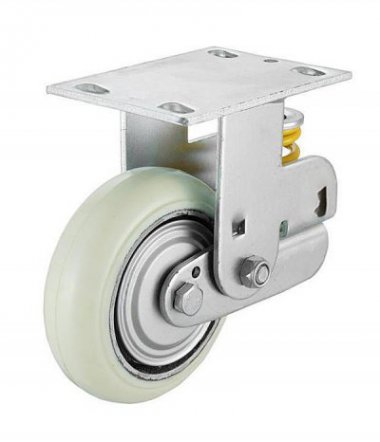
Our FFIBU high-temperature casters are widely specified for:
Food & Bakery — Oven racks, proofing carts, and cooling trolleys in commercial bakeries.
Heat Treatment & Metalworking — Kiln cars, annealing furnace carts, and foundry transfer trolleys.
Powder Coating & Finishing — Curing-oven racks that cycle in and out of heated zones.
Pharmaceutical & Lab — Dry-heat sterilizers and autoclave carts requiring repeated thermal cycling.
When specifying high-temp casters, consider:
Peak & Continuous Temperature — Confirm the wheel material's rating exceeds your highest expected temperature.
Load Capacity — Include a safety margin; heat can affect bearing performance over time.
Moisture Exposure — For steam autoclaves or washdown areas, choose glass-filled nylon or stainless rigs rather than phenolic (which prefers dry heat).
Wheel Diameter — Larger diameters roll more easily over thresholds and dissipate heat better.
Bracket Finish — Stainless steel or high-temp zinc plating for corrosion + heat resistance in demanding plants.
At China Zhongshan FFIBU Casters Co., Ltd, every FFIBU high-temperature caster is manufactured under strict quality control and tested for thermal stability, ensuring your oven racks, kiln carts, and processing trolleys keep rolling—shift after shift, heat cycle after heat cycle.
Let me know if you'd like a High-Temp Caster Specification Sheet or a comparison flyer of Phenolic vs. Glass-Filled Nylon wheels to go with this article!
 中文简体
中文简体  English
  Español
  العربية
  Français
  Русский
  Português
  Deutsch
  日本語
日本語  한국어
한국어  Tiếng Việt
  हिन्दी
  Italiano
  Nederlands
  Türkçe
  Polski
  ไทย
ไทย  Română
  বাংলা
বাংলা  Українська
  עברית
עברית  Lietuvių
  Bahasa Indonesia
  Svenska
  Magyar
  Dansk
Dansk  Suomi
Suomi  Čeština
  Ελληνικά