Select Language
As modern electronics shrink to micron-level precision, the greatest threat to product quality is often invisible. Electrostatic Discharge (ESD)—a silent spark as small as 30 volts—can destroy sensitive semiconductors, degrade PCB performance, or cause latent failures in finished devices. With the global boom in semiconductor fabrication, SMT assembly lines, and AI hardware production, anti-static (ESD) casters have rapidly evolved from an optional upgrade to an essential component of any ESD-protected area (EPA). At China Zhongshan FFIBU Casters Co., Ltd, our FFIBU ESD caster series is engineered to keep static-sensitive manufacturing environments safe, compliant, and productive.
When a standard cart rolls across a non-conductive wheel, friction between the tire and floor generates static charge. Because ordinary wheels act as insulators, that charge accumulates on the cart body until it finds an unintended discharge path—often through a microchip, sensor, or circuit board being transported. In high-yield electronics plants, a single ESD event can scrap an entire batch of wafers or assembled boards.
FFIBU anti-static casters use specially formulated conductive or static-dissipative wheel materials—typically ESD polyurethane (PU) or conductive rubber—with carbon black or dissipative additives blended uniformly throughout the wheel volume. This creates a continuous low-resistance path:
Cart Frame → Metal Caster Bracket → Conductive/ESD Wheel → ESD Flooring → Earth Ground
The key performance indicator is surface/point-to-point resistance:
Static Dissipative (ESD Casters): 10⁶ – 10⁹ Ω — the most common spec for electronics assembly and cleanrooms; safely bleeds off charge without abrupt discharge.
Conductive Casters: < 10⁵ Ω — used in semiconductor fabs and explosive-risky areas where fastest possible charge dissipation is required.
Component Protection: Prevents ESD damage to ICs, BGAs, LCD panels, and sensitive electronics during intralogistics.
Cleanroom Compatibility: Non-marking PU formulations minimize particulate shedding and leave no black streaks on ESD vinyl or epoxy floors.
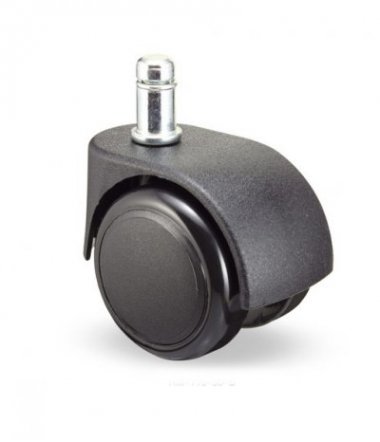
Complete Grounding Path: Metal-to-metal contact between axle, fork, and top plate ensures no insulating barriers interrupt the discharge route.
Low Rolling Resistance & High Load: PU treads offer smooth, quiet movement with load ratings suited for heavy fixture carts, AGVs, and server rack trolleys.
Our FFIBU anti-static casters are specified across:
Semiconductor & Wafer Fabs – FOUP carts, reticle carriers, and sub-fab material trolleys.
SMT & PCB Assembly Lines – Feeder carts, WIP racks, wave-solder in/out-feed carts.
Optoelectronics & Display Manufacturing – Panel handling carts and module assembly stations.
Data Center & AI Hardware Assembly – Server rack assembly carts and test-burn-in transporters.
Cleanroom Labs & Medical Electronics – ESD-safe instrument carts and sterile-area trolleys.
When specifying ESD casters, verify:
Resistance Range – Match to your EPA program (typically 10⁶–10⁹ Ω for dissipative).
Wheel Material – ESD PU for cleanrooms and non-marking needs; conductive rubber for maximum grip and faster dissipation.
Bracket Construction – Zinc-plated or stainless steel with ensured metal-to-metal continuity; avoid painted/insulated axle sleeves.
Floor Compatibility – Confirm suitability with your ESD flooring type (vinyl tile, epoxy, raised access with ESD carpet).
At China Zhongshan FFIBU Casters Co., Ltd, every FFIBU anti-static caster is resistance-tested to ensure stable performance across humidity variations and load conditions. In today's electronics manufacturing landscape, ESD control is non-negotiable—and the right caster is your first line of defense on every rolling cart in the plant.
Would you like me to also draft a one-page ESD Caster Technical Data Sheet (with resistance specs & wheel options) to accompany your FFIBU product catalog?
 中文简体
中文简体  English
  Español
  العربية
  Français
  Русский
  Português
  Deutsch
  日本語
日本語  한국어
한국어  Tiếng Việt
  हिन्दी
  Italiano
  Nederlands
  Türkçe
  Polski
  ไทย
ไทย  Română
  বাংলা
বাংলা  Українська
  עברית
עברית  Lietuvių
  Bahasa Indonesia
  Svenska
  Magyar
  Dansk
Dansk  Suomi
Suomi  Čeština
  Ελληνικά